Mature trees can bring structure, character and valuable greenery to a garden. However, when several trees are growing too closely together, their combined canopies may block much of the available light and leave the space below feeling enclosed.
Selective tree felling can sometimes create a more balanced garden by removing unsuitable or poorly positioned trees while retaining those that contribute most to the landscape. For property owners in Sherston, Gloucestershire, the key is to assess the whole group carefully rather than removing trees simply because the garden feels shaded.
How Selective Tree Felling Can Improve an Overcrowded Garden
Tree felling does not need to mean clearing the entire garden. In many cases, removing one dominant, declining or badly positioned tree can improve light levels, create more usable space and allow the remaining trees to develop more naturally.
A professional assessment should consider each tree’s condition, species, size, position and relationship with the rest of the garden.
Allowing More Natural Light Into the Garden
A dense canopy can prevent sunlight from reaching lawns, borders, patios and windows. The effect is often strongest where multiple crowns overlap or a large tree stands close to the property.
Removing a carefully selected tree can create an opening through which more daylight reaches the garden. The improvement depends on the direction of the sun, the height of the surrounding trees and the density of their foliage.
This is why felling the largest tree is not automatically the most effective solution. A smaller tree in a critical position may be responsible for more shade at the times when the garden is normally used.
Creating Space for Remaining Trees
Trees growing too closely together compete for light, water and soil nutrients. As they extend towards available daylight, they can develop uneven crowns, leaning growth or long lateral branches.
Selective removal creates more room around the retained trees. This can reduce overcrowding and allow their crowns to develop with less interference from neighbouring growth.
The remaining trees should be reassessed after felling because their exposure to wind and sunlight may change. Their future growth should form part of the original plan.
Improving Conditions for Lawns and Planting
Dense shade and competition from roots can make it difficult for grass and other plants to grow successfully. The soil beneath crowded trees may also remain dry because the canopies intercept rainfall while the roots draw moisture from the ground.
Removing one or more unsuitable trees can improve light and reduce competition. This may give lawns, borders and shrubs a better opportunity to establish.
Results will depend on the remaining canopy, soil conditions and the plants selected. Felling can improve the growing environment, but it does not instantly correct compacted soil or restore areas that have been shaded for many years.
Making the Garden Feel More Spacious
A tree does not need to be unhealthy to dominate a limited garden. A broad trunk, low branches or a wide canopy can divide the space and restrict how it is used.
Removing a poorly positioned tree may:
- open up views across the garden
- create room for seating or planting
- improve access to sheds and gates
- make paths easier to use
- reduce congestion around other trees
- allow a clearer garden layout
The space left behind should be considered before work begins. Planning its future use helps ensure that removal contributes to a coherent design.
Reducing Excessive Debris and Damp Shade
Heavily wooded gardens can receive substantial quantities of leaves, small branches, seeds and other natural debris. In areas where sunlight and air movement are limited, surfaces may also remain damp for longer.
Selective felling can reduce the volume of overhanging growth above patios, paths and lawns. Opening the canopy may also improve airflow and help some areas dry more readily after rainfall.
This will not eliminate ordinary seasonal debris, especially where mature trees remain, but it can reduce the concentration caused by overcrowding.
When Felling May Be More Suitable Than Pruning
Professional pruning or crown reduction can often manage an overgrown tree while preserving it. These options may be appropriate where the tree is healthy and the problem is caused by particular branches or an oversized crown.
Felling may deserve consideration where:
- the tree is unsuitable for its available space
- its crown is heavily suppressed by neighbouring trees
- repeated pruning would not resolve its position
- its removal would significantly improve the remaining group
- the tree is declining or structurally compromised
- the trunk and roots prevent practical use of the garden
The best approach may combine selective felling with careful pruning of retained trees. This avoids removing more than is necessary.
Why Professional Planning Matters
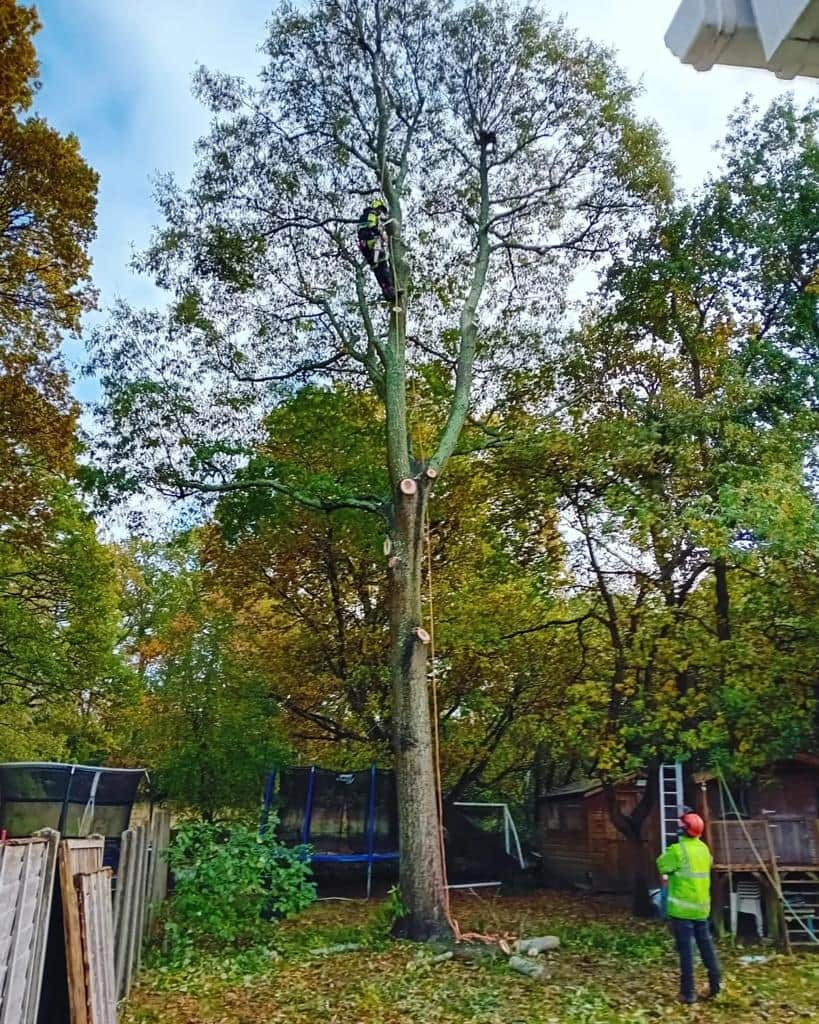
Tree felling in an overcrowded garden requires control and careful sequencing. Nearby trees, fences, buildings, planting and garden structures can all restrict the available working area.
A professional tree surgeon can assess how the tree should be dismantled and how sections can be lowered without unnecessary disturbance. The condition of neighbouring trees should also be considered before they are exposed to a more open environment.
The assessment should establish:
- which trees are contributing most to the problem
- which specimens are suitable to retain
- whether pruning could achieve the required result
- how removal may affect light and wind exposure
- whether the stump should remain or be ground out
- how the cleared area could be used afterwards
This considered approach helps preserve the strongest features of the garden while addressing overcrowding effectively.
Managing the Stump After Felling
Felling normally leaves a stump and root system in the ground. If the area is intended for new planting, lawn or another garden use, stump grinding may be recommended.
Grinding reduces the main stump below the surrounding level and creates a more usable surface. The appropriate depth depends on what is planned for the area afterwards.
Discussing stump management before felling avoids leaving an obstacle in a space that was intended to become more functional.
Conclusion
Selective tree felling can open up a dark and overcrowded garden by improving light, reducing competition and creating more usable space. The greatest benefit usually comes from removing the right tree rather than the greatest number of trees.
If your garden in Sherston, Gloucestershire feels dominated by crowded or poorly positioned trees, EM Tree Surgery Sherston can assess the complete group and explain whether selective felling, pruning or a combination of both would be most appropriate. Contact our team to arrange a professional tree assessment.
Call us on: 01666 337 167
Click here to find out more about EM Tree Surgery Sherston
Click here to complete our contact form and see how we can help with your trees needs.